

America’s new blind spot
Some people who use bioinformatics software have a favorite program. Mine is Geneious, because I am a baby who appreciates an easy, nice interface. Others like BioEdit. Chromas/ChromasPro. A scientist will end up using all of these programs for different reasons. The bioinformation they are working with are DNA, RNA, or protein sequences. They are saving the sequences of these data from each case of a disease, so that when there is a change in the sequence, they will see it. They’ll name it. They’ll track it. That is what scientists at the US Centers for Disease Control and Prevention (US CDC) used to proactively do for several pathogens, including the bacteria Campylobacter, the parasite Cyclospora, Listeria, Shigella, Vibrio, and Yersinia enterocolitica. Many of us are now familiar with this process because of COVID variants. Every one of these bugs are different in how much they change over time. For each of them, different changes (e.g., changes that can affect the bug’s transmission or virulence) are important for scientists to be aware of in order to keep them under control and prevent disease.
To be clear: the US CDC still tracks each of these bugs in a “passive” way. Camplyobacter, Cyclospora, Listeria, Shigella, Vibrio, and Yersinia enterocolitica are still all reportable (notifiable) diseases to the CDC. FoodNet was not created to be used in identifying emerging outbreaks. If an outbreak is happening, especially one as large as the 2026 Taylor Farms-associated iceberg lettuce Cyclospora outbreak, the CDC will know about it. What FoodNet did was add an extra alert system, one that go ahead of the curve. Proactive surveillance. Other programs, like PulseNet and CryptoNet—a system made for Cryptosporidium specifically—also do this for several pathogens. Therefore, downsizing of FoodNet likely did not impact the response time for this outbreak, but it does impede scientists’ ability to potentially anticipate and even predict future outbreaks and nip them in the bud.
I will not bore you too much with personal anecdotes like this is an online cooking recipe (get to the point!), but I am intimately familiar with these disease surveillance systems. My initial student work-study position at CDC’s main campus in Roybal, next to Emory University, was being a database manager for CDC’s CryptoNet. As previously mentioned, that system is for a parasite similar to Cyclospora called Cryptosporidium. An important distinction between the two, however, is that Cryptosporidium is much more genetically diverse and heterogenous than Cyclospora and much easier to extract DNA from, which makes Cyclospora’s lack of tracking in FoodNet less critical than it would be for Cryptosporidium, as an example comparison. Read more about FoodNet from the University of Minnesota’s Center for Infectious Disease Research and Policy (CIDRAP), here.
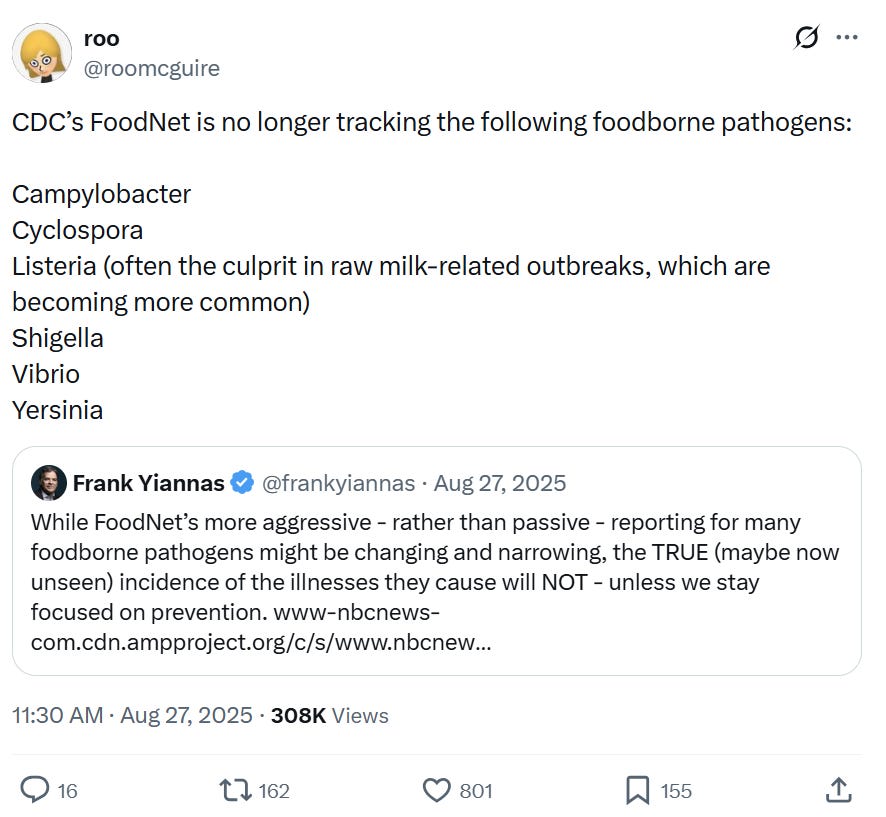
More importantly than the downsizing of FoodNet, the current widespread Cyclospora public health event is mired by the fact that the specific CDC laboratory that investigates this parasite has been downsized and state and local health departments’ funding severely cut.
What is Cyclospora? “Explosive diarrhea”
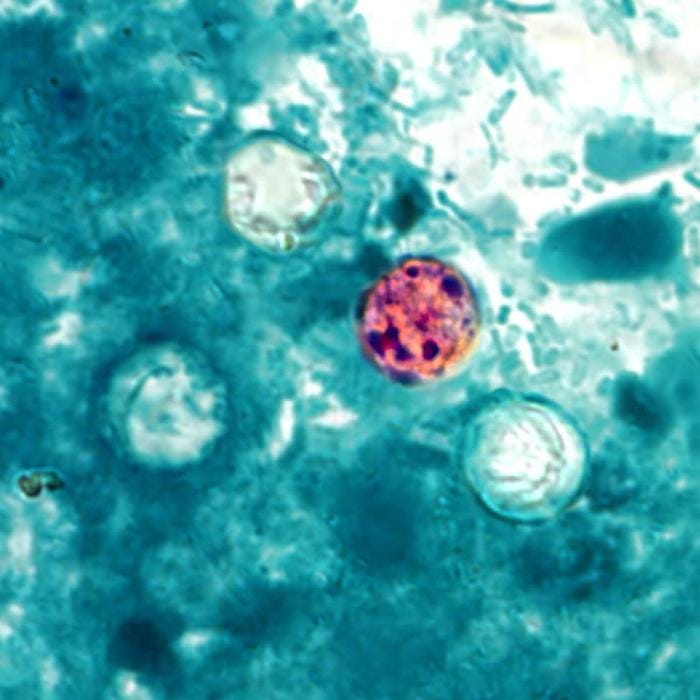
There are three enteric—of, relating to, or occurring within the intestines—parasites that are most common, of varying size: Cryptosporidium, Cyclospora, Giardia. They are protozoans: “one-celled animals.” Coccidia: parasitical “one-celled animals” that are spore-forming—spores being a unit of sexual (for fungi) or asexual reproduction, adapted for dispersal or survival. For the parasite Cyclospora, these spores are called oocytes. Below is a helpful chart from CDC of the lifecycle and exposure pathway of Cyclospora and its oocytes.
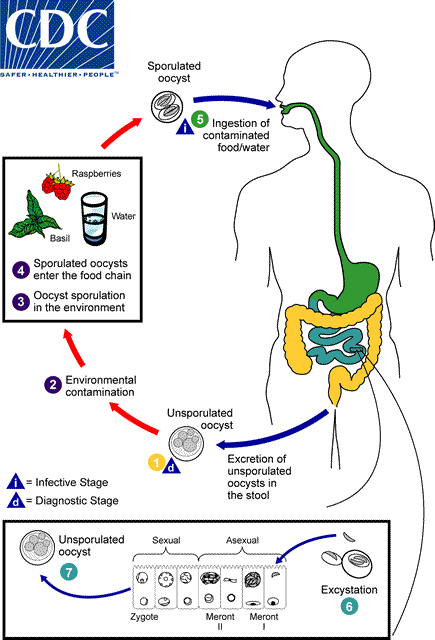
Formerly accompanying caption (no longer available on CDC website):
When freshly passed in stools, the oocyst is not infective (1) (thus, direct fecal-oral transmission cannot occur; this differentiates Cyclospora from another important coccidian parasite, Cryptosporidium). In the environment (2), sporulation occurs after days or weeks at temperatures between 22°C to 32°C, resulting in division of the sporont into two sporocysts, each containing two elongate sporozoites (3). Fresh produce and water can serve as vehicles for transmission (4) and the sporulated oocysts are ingested (in contaminated food or water) (5). The oocysts excyst in the gastrointestinal tract, freeing the sporozoites which invade the epithelial cells of the small intestine (6). Inside the cells they undergo asexual multiplication and sexual development to mature into oocysts, which will be shed in stools (7)…
Symptoms
The Cyclospora parasite causes a gastrointestinal illness called Cyclosporiasis. If you get cyclosporiasis, you may or may not experience symptoms. The most common symptom is watery and potentially frequent diarrhea, often described in mainstream media as “explosive diarrhea.” Cyclosporiasis symptoms can be different for everyone.
Symptoms usually emerge about a week from exposure and infection (e.g., consumption of contaminated iceberg lettuce in a salad), although they may emerge as little as 2 days and as long as 2 weeks or more after. You should contact your healthcare provider if you suspect you are experiencing symptoms of cyclosporiasis. Healthy people usually recover from the illness on their own, but the disease can be more severe, linger/last longer than what is typical, or even disappear and return once or multiple times in some people. The latter observation is not well understood by health experts.
Seeking treatment can help speed up recovery, as well as staying well-hydrated (meaning you should drink enough water so that your urine stays a pale yellow color and you urinate regularly). If not treated, cyclosporiasis can last from several days to over a month.
In addition to watery diarrhea, cyclosporiasis symptoms include:
loss of appetite, weight loss, cramping, bloating, gas, nausea, fatigue
less commonly can include vomiting, body aches, headaches, and even a low-grade fever (between 99.5°F (37.5°C) and 100.3°F (37.9°C)).
Fatigue, in particular, is a symptom that may linger.
Risk factors
Children, the elderly, and the immunocompromised are at highest risk for severe illness and/or complications from severe dehydration resulting from cyclosporiasis. Usually, travel to the tropics or subtropics is a risk factor as well. Prior to this year, cyclosporiasis was fairly uncommon in the US, typically only reporting a couple thousand cases (e.g., for 2018 through 2022, the annual average was 3,285 cases).
Cyclosporiasis outbreaks and cases have been associated with consumption of several types of food, as well as contaminated water. Generally, you are going to be concerned about produce that is more difficult to wash (onions have layers…). Past foods linked to cyclosporiasis include:
Herbs: Basil, cilantro, and parsley
Fruits and berries: Fresh (usually not frozen) raspberries, mixed berry or pre-cut fruit trays
Leafy greens: lettuce, pre-cut or any bagged salad kits, cabbage
Vegetables: green onions, snow peas, sugar snap peas, and broccoli
I was not able to find this easy list on CDC’s website, which is unfortunate, frustrating for concerned consumers, and why I write Roo McGuire Health for you.
So please also consider supporting this newsletter by becoming a paid or free subscriber. I will never paywall a post with important health information for the public, only silly articles, so the publication relies on your generous subscriptions.
In addition to food, often in tandem (e.g., contaminated water sprayed on aforementioned produce in agricultural fields) cyclosporiasis outbreaks and cases have been associated with:
Untreated surface water: Drinking or using water from streams, lakes, and ponds to wash food
Recreational water: Swimming in or swallowing water in contaminated pools or water parks (Yes, Cyclospora parasites are completely resistant to bleach and chlorine)
Contaminated agricultural water: The most common source of cyclosporiasis outbreaks includes irrigational/agricultural water food safety failures, often resulting from poor and abusive labor practices (inadequate sanitation and lack of time allotted for bathroom breaks). This is cruel and should be aggressively addressed/cracked down on by the next administration and a proper socialist movement.
It takes 1 to 2 weeks after Cyclospora passes in the bowl movement and outside of the body for it to become infectious (see above diagram). Because of this, human-to-human transmission is extremely unlikely. The most likely source of exposure is consumption of food or water contaminated with feces.
Diagnosis and reporting
If you have symptoms of cyclosporiasis, it is recommended that you see your healthcare provider. Your provider may have to request a special laboratory test of your poop for Cyclospora because routine testing does not look for this parasite. Your provider may ask you to submit more than one sample on different days.
If you are a healthcare provider or laboratory scientist, here is more information on how to make the cyclosporiasis diagnosis.
Cyclosporiasis cases in the US, probable, suspected, and laboratory-confirmed should be reported to public health authorities. A healthcare provider will do this for you. Healthcare providers will report these cases to local and state health departments. These department will in turn report these cases to the US CDC.
Treatment
Cyclosporiasis is treated with antibiotics, rest, and fluids (rehydration). If you are a healthcare provider, here are recommendations for treating patients with this parasite.
Summary of the widespread health event & CDC declaring the Taylor Farms iceberg lettuce outbreak over
CDC has reported 19,595 laboratory-confirmed cases of cyclosporiasis in 49 states and Washington, DC. This case count has not been updated since August 31st, 2026, as of writing this article (9/12/2026). This is a very, very large, concerning, widespread public health event.
In fact, this is the most amount of annual cyclosporiasis cases the US has ever seen.
The largest outbreak (more than 12,000 cases) in this widespread health event, a multi-state outbreak that proved to be associated with Taylor Farms de Mexico’s iceberg lettuce, has been declared over by the CDC. The FDA’s investigation into this outbreak is still ongoing.
The best-by dates for the recalled lettuce have passed and the product is therefore no longer available in stores or restaurants. Recall information includes Marketside-brand product available at Walmart described as “Iceberg Salad 12-oz or 24-oz” and “Shredded Lettuce 8-oz or 16-oz” with Best if Used By dates of 7/18/2026 to 8/3/2026. I informed the public that cases would slow after 8/3/2026, and they have. Taco Bell also used this supplier.
Food service (restaurants) high-risk states for Taylor Farms lettuce:
Confirmed: AL, AR, CT, FL, GA, IA, IL, IN, KS, KY, LA, MA, ME, MD, MI, MO, MS, NC, NE, NH, NJ, NY, OH, OK, PA, SC, TN, TX, VA, WI, and WV.
Possible: DC, DE, ND, PR, RI, SD, VT, and WA.
Retail stores (grocery) high-risk states for Taylor Farms lettuce:
AL, AR, FL, GA, IN, KS, KY, LA, MO, MS, OK, TN, TX, VA, WV.
More detailed recall information is available here.
What about the other cases?
Troublingly, that leaves some 7,000 cases of cyclosporiasis potentially associated with a different source, or a related primary source (e.g., contaminated agricultural water used in Mexico, which is what I personally suspect). The primary source for the Taylor Farms lettuce outbreak, and the outbreaks and clusters that comprise of the other cases that have not been established as Taylor Farms lettuce-associated, has not been identified. There are seven distinct outbreaks/clusters. Traceback efforts are ongoing and an aggressive crackdown on agricultural labor practices are recommended. There is no cohesive food source that has been identified for the six other outbreaks yet.
As mentioned earlier when discussing the utility of FoodNet, tracing the primary and secondary sources for Cyclospora can be difficult because of its biology. The difficulty is worsened by budget and public health staffing cuts on the federal, state, and local levels.
Your public health recommendations
To reduce your risk of cyclosporiasis, you can do the following things:
Primary recommendations
Wash your hands.
Wash fresh produce thoroughly under cold, clean running water before you eat, cut, or cook it.
Cook produce from the list above to a minimum temperature of 158 °F (70°C). Washing alone does not guarantee that the parasite will be removed.
Follow food recalls and outbreaks and do not eat recalled food. FDA reports recalls on its website, as well as on Twitter. There are also two apps (not sponsored) for recall tracking, RecallSentry and Yuka, which allow you to scan product barcodes to see if they are on an FDA recall list.
Extra recommendations
Look at CDC’s map to determine if you are in a high-risk state.
Note that this map includes the Taylor Farms iceberg lettuce outbreak (see states listed above; mostly midwestern and eastern states) and that outbreak is considered over.
The separate, non-lettuce-associated outbreaks are associated with 18 different states, with a distinct concentration of cases in North Carolina and other southern states.
Look at the list of foods from above in this article, as well as note if you are part of a high-risk group, and determine if you are comfortable with consuming these foods while the additional outbreaks’ source and the primary source for the Taylor Farms lettuce outbreak are still unknown. You may cook these produce to the aforementioned minimum temperature if you would like to decrease your risk of cyclosporiasis. You may also remove the outer layers of produce to reduce your risk.
Vinegar does not kill the Cyclospora parasite, although soaking the produce in a diluted vinegar solution (one part vinegar and three parts water) may help physically wash or rinse some parasites off the surface of the produce. The evidence on this is mixed, however.
The Cyclospora parasite’s oocysts have a very tough outer shell and it is resistant to household acids and disinfectants, as mentioned above regarding bleach and chlorine use in recreational water.
Consider opting for local or frozen produce for the particular food types listed above as well.
TLDR; Yes, you can and should eat fresh vegetables in the US, including iceberg lettuce, but proceed with caution while the current outbreak source(s) are unknown, especially if you are high-risk. Follow the above recommendations to reduce your risk of cyclosporiasis.
Author
Miranda M. Mitchell, MPH
Publication: Roo McGuire Health will cover emerging public health topics in the US and globally, aiming to resist Trump’s anti-science agenda and provide credible health information during the current “information blackout” caused by government and academic funding cuts.

Author: Miranda Mitchell, MPH (“Roo McGuire”) is an environmental health scientist. Opinions are her own and do not represent the institutions she was previously affiliated with. She is a graduate of Emory University and Emory University’s Rollins School of Public Health, as well as former intern at the Office of Children’s Health at US EPA Headquarters in Washington, D.C., graduate work-study at US CDC Headquarters at its Roybal Campus in the National Center for Emerging Zoonotic Infectious Diseases (NCEZID), Oak Ridge Institute for Science and Education (ORISE) fellow and full-time employee at US Agency for Toxic Substances and Disease Registry (ATSDR) at US CDC’s Chamblee Campus. Her Master’s thesis, published in Emerging Infectious Diseases (EID), investigated the potential transmission dynamics and genetic diversity of a bacteria in bats and their ectoparasites. Her areas of expertise are health risk assessment, environmental health science, molecular biology, and infectious disease epidemiology. She currently makes public health and political educational content here and on Twitch.tv/roomcguire, while she awaits her first child and hopes to pursue a doctorate sometime after 2028. She has never received any money from pharmaceutical companies and declares no conflicts of interest.